

Posted 23 July 2026
A systems model for how truth transforms change into growth
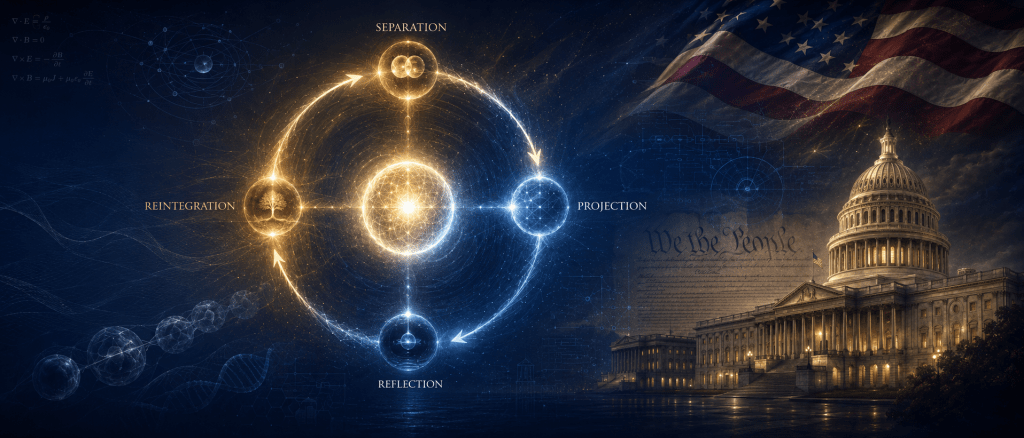
Separation → Projection → Reflection → Reintegration
What Is It?
The holomorphic process is a four-stage model—Separation, Projection, Reflection, and Reintegration—for understanding how change can become constructive rather than ineffective or destructive.
Change does not become constructive merely because something new has been imagined or projected into the world. A healthy process must also test every projection against reality, reflect on the results, correct the resulting error, and reintegrate what proves sufficiently true. The completed cycle provides a common framework for examining living systems, personal growth, learning, institutional change, constitutional government, and other processes that depend upon feedback and self-correction.
At the physical level, the model considers information as patterned, or information-modulated energy interacting with a more uniform background field. When projected information corresponds sufficiently with truth, that relationship may produce a stable, self-sustaining unit of organized reality—a projection that has a reflection in truth. It becomes energy that is in-formed and is therefore doing something constructive rather than existing merely as the potential to do something. In this sense, the model distinguishes energy, understood as the capacity for action, from power, understood as differentiated energy actively producing or sustaining a real effect.
The holomorphic process therefore asks whether the same basic cycle that transforms experience into understanding may also help explain the relationship among information, energy, and physical form. This physical interpretation remains a proposed extension of the model rather than an established scientific theory.
The model begins with a simple proposition:
Truth is the reference by which error can be recognized, corrected, and transformed into understanding.
But the question that has been asked throughout the ages is what is truth?
What Is Truth?
I hope that everyone can agree that at the most fundamental level, truth is what is true.
Stated more emphatically, truth is the only thing that is true. This may sound like a tautology—a statement so self-evident that it proves nothing—but it establishes the indispensable and unchangeable starting point for reflection. To deny it, we would have to make another self-evident claim about what is true. Belief does not create truth. Consensus does not create it. A persuasive story does not become true because it is repeated, reinforced, or accepted by many people. These are projections of what we might think to be true. But truth is the stable reference beyond those projections: information that faithfully corresponds with reality—what actually is, whether or not we perceive it completely or correctly. Because human knowledge is finite and revisable, we should not assume that we possess truth absolutely. We orient ourselves toward it by testing what we think against reality. Truth is therefore the reference by which error can be recognized, correction can occur, and experience can be transformed into understanding.
The Process as a Closed-Loop System
The holomorphic process is modeled here as a basic closed-loop feedback system.
This approach is consistent with the systems perspective developed by Fritjof Capra and others, in which living systems are understood not merely as collections of separate objects, but as dynamic networks of relationships, interactions, feedback, and self-organization. A living system survives and develops because it remains responsive to the larger reality in which it exists.
For purposes of the holomorphic model, the input is the existing whole—the reality or present condition from which a cycle of change begins. The system does not begin from nothing. It begins with something already present, organized, and functioning, although perhaps incompletely understood.
A differentiation then occurs within that whole. The differentiated parts are projected as sufficiently separate to be identified, examined, and acted upon. Projection carries one of those possibilities through the forward path and produces an output: an idea, interpretation, action, design, behavior, or changed condition.
A sample of that output is then returned through the feedback path. At the comparator, the feedback is brought into relationship with the original reference—with reality as far as the system is capable of observing and representing it. The difference between the projected result and the measured condition generates the error signal.
Error does not necessarily mean that the system is defective or that the projection was entirely wrong. It is information about the amount and direction of correction that may be required. In the holomorphic model, the comparison also performs an integrating function: it reconnects the projected part with the whole from which it was differentiated.
The cycle can then correct itself, incorporate what has been learned, and begin again from a changed starting point.
The Four Stages
1. Separation
Every cycle begins with an existing whole.
Separation is a differentiation within that whole. A distinction becomes visible between one part and another, between what is known and unknown, or between what presently exists and what might be possible.
The differentiated parts are then perceived or represented as separate enough to be examined independently. A cell divides; a pregnant woman gives birth; a child develops an individual identity; A single mind functionally differentiates into a relatively stable, cumulative Knowing Mind, which serves as the system’s evolving reference, and a dynamic Thinking Mind, which projects possibilities into the unknown. At larger scales, a physicist conceptually distinguishes the relatively stable spatial configuration of a physical system from its dynamic evolution through time. A society distinguishes competing interpretations of a common problem so that they can be projected, compared with reality, and corrected in the continuing search for truth.
Separation does not mean that the differentiated parts have ceased to belong to the larger whole. It creates the freedom and perspective necessary for further development.
In the feedback model, Separation begins when a difference becomes detectable. That difference opens the loop and creates the possibility of change.
2. Projection
What has been differentiated is extended outward into thought, expression, action, or experience.
The Thinking Mind forms an interpretation, proposes a solution, imagines a future, designs a system, or acts upon the world. In control-system language, Projection is the forward path through which the system produces an output.
Projection is a necessary part of the process, but it does not complete it. A healthy society must therefore allow children to practice projecting—to form an answer, attempt a solution, imagine an outcome, take a risk, and discover what follows. When adults try to spare children from this effort by giving them answers before they have struggled with the question, they may reduce frustration in the moment, but they also deprive the child of an essential stage of development. The child learns to receive conclusions rather than generate possibilities. Education should not eliminate difficulty; it should provide challenges that require the learner to project, receive feedback, reflect, and correct. Otherwise, the child may become dependent on external direction and less able to think independently when no answer is supplied.
An idea can appear coherent within the mind and still fail when tested against reality. This is especially likely when the idea reinforces an earlier idea, is supported by people who already share it, or is repeated often enough that it begins to reflect upon itself. Repetition can create familiarity, confidence, and internal coherence, but it cannot by itself create truth.
When Projection becomes its own reference, the system no longer operates as a healthy closed loop. It feeds its assumptions back into itself, amplifying the original projection rather than correcting it.
3. Reflection
Reflection returns a sample of the projected output through the feedback path.
The result is brought back to the comparator and examined in relationship to the existing whole. Expectations are compared with consequences. Interpretations are compared with evidence. Beliefs are compared with experience. The projected model is compared with reality as accurately as the system can observe it.
The resulting difference is the error signal.
Error is not condemnation. It is corrective information. It tells the system whether the projection reduced the original discrepancy, increased it, or created a new one. Reflection therefore requires more than looking back at our previous thoughts. It requires exposing those thoughts to something beyond themselves.
A system that compares one projection only with another projection may achieve internal consistency while drifting farther from reality. Genuine reflection restores the external reference.
4. Reintegration
What has survived reflection is incorporated into a more coherent whole.
The projection may be accepted, corrected, limited, combined with something else, or abandoned. What has been learned becomes part of the system’s accumulated structure, changing the starting condition for the next cycle.
Reintegration therefore changes our perception of reality. When an idea is translated into action, it can also change the reality in which we and others must live.
That gives the process an ethical and practical dimension. The question is not merely, Can we change reality? The deeper question is:
How do we want to change it?
Not every change produces growth. A system can overcorrect, oscillate between extremes, amplify its own error, or become unstable. A political reform can create consequences its advocates did not anticipate. A technology can solve one problem while producing several others. An individual can escape one limiting belief only to become trapped in another. In Suicidal Empathy, Dr. Gad Saad warns that even empathy—normally an essential human virtue—can become maladaptive when it is applied selectively, elevated above truth and judgment, or insulated from the consequences it produces. A policy may feel compassionate because it relieves the suffering immediately visible to us while transferring greater costs, danger, or injustice to people whose suffering is less visible.
In systems terms, benevolent intention is not sufficient evidence of beneficial output. The results must be reflected against the whole reality, including long-term consequences and effects on every part of the system. Otherwise, compassion intended to preserve the whole may unintentionally weaken the conditions that allow compassion, freedom, and social order to survive.
Healthy reintegration therefore does not declare the new output perfect or final. It incorporates what has proved sufficiently true while preserving the system’s capacity for continued feedback and correction.
The completed cycle becomes the existing whole from which the next differentiation begins.
Why the Complete Cycle Matters
Modern culture is highly effective at separation and projection. We divide into identities, disciplines, parties, institutions, and specialized fields. We then project theories, policies, technologies, opinions, and competing visions of the future.
The tragic irony appears when a projection intended to improve society is implemented on a massive scale before it has been adequately tested—and is then protected from corrective feedback. Mao Zedong’s Great Leap Forward provides an extreme example. Beginning in 1958, the Chinese government attempted to eliminate poverty and accelerate the development of a modern communist society through collectivized agriculture, centralized production, and rapid industrialization. Yet the program rested on unrealistic assumptions about what central planning and mass mobilization could accomplish. Agricultural labor and resources were diverted into industrial projects, government procurement removed excessive amounts of grain from rural communities, and officials reported inflated production figures because acknowledging failure could be dangerous. The result was not abundance but collapsing agricultural output and a catastrophic famine in which scholarly estimates range from approximately 15 million to 45 million deaths.
The irony could hardly be more severe: a program projected as a means of overcoming scarcity helped produce one of the greatest famines in history. In holomorphic terms, the initial theory became its own reference. Reports were adjusted to conform to the projection rather than allowing reality to correct it. Dissent and unfavorable evidence were suppressed, so false information was fed back into the governing system as confirmation of success. The problem was therefore not simply that the original projection contained error; every large human undertaking does. The catastrophe occurred because the system progressively disabled the reflection required to recognize and correct that error. Our greater difficulty lies in reflection and reintegration.
The danger is not confined to history.
The Biden administration pursued rapid, large-scale change through executive orders, emergency authorities, agency rulemaking, and major legislation, including COVID-19 relief and public-health requirements; reversals in immigration and border policy; student-debt cancellation initiatives; and extensive infrastructure, semiconductor, clean-energy, environmental, labor, and regulatory programs.
The Trump administration likewise has pursued rapid, large-scale change through executive orders, emergency authorities, and agency directives, including sweeping tariffs; DOGE-led reviews and cancellations of federal programs, grants, contracts, and leases; reductions and restructuring of the federal workforce; broad regulatory changes; and accelerated changes in immigration policy and enforcement.
Opposition does not automatically constitute reflection. Movements such as the Democratic Socialists of America propose even more drastic and fundamental changes, including a new constitution, a “democratic socialist republic,” and public ownership of major industries. Such projections carry an extraordinary burden of proof in light of the historical dangers of concentrating economic and political power.
Neither electoral victory nor opposition to those in power proves that an idea is true, constitutional, or beneficial. When each side answers the other’s excesses with a stronger counter-projection, American politics becomes an unstable feedback system: the oscillation grows while the nation absorbs the stress.
Truth is not determined by which side projects an idea. Every projection must be reflected against reality.
When individuals or institutions reject corrective feedback, projection becomes self-reinforcing. Differences harden into fragmentation. Political challenges become crises. Organizations repeat mistakes because they defend their previous decisions rather than learn from the consequences of those decisions.
The holomorphic process does not tell Americans which party or policy is correct. It asks whether our political system remains capable of discovering and correcting error.
In a free society,
- Separation allows citizens and parties to hold different views without ceasing to belong to the same constitutional whole.
- Freedom permits Projection by allowing those views to be expressed as arguments, platforms, laws, and policies.
- Truth makes Reflection possible because political claims can be tested against evidence, constitutional principles, lived experience, and the consequences they produce.
- Reintegration converts correction into growth when what has been learned is incorporated into better laws, institutions, and civic judgment without demanding uniformity or destroying legitimate opposition.
America therefore depends upon more than the freedom to project competing visions. It depends upon the willingness to reflect honestly, accept correction, and carry what proves true into the next cycle of self-government.
Three Areas of Inquiry
Physics and Engineering
The holomorphic process began as an effort to understand reality through holography, systems analysis, resonance, control theory, information, energy, feedback and coherence.
This part of the work is an ongoing, unfunded research project. Some connections are based on established physical and engineering principles; others are interpretive analogies or testable hypotheses that require further development and critical review.
The purpose is not to force physics into a strict process philosophy, but to ask whether a process-centered model can reveal relationships that object-centered models tend to separate without reflection or reintegration.
The Individual and Living Systems
The process can be used to examine perception, learning, personal development, biological continuity, conscience, and the relationship between the Thinking Mind and the Knowing Mind.
A person projects ideas and interpretations into the world, receives feedback, reflects on the results, and incorporates what proves sufficiently true–having an acceptably small amount of uncertainty–into their Knowing Mind. Over time, this process can form a more coherent and mature self.
The problem arises when an untested—and especially a false—projection is reintegrated as though it were true. It then becomes part of the person’s perspective and helps shape how later experience is perceived and interpreted. Future projections may reinforce the original error, creating an internally coherent worldview that nevertheless departs increasingly from reality. Healthy development therefore depends not merely on completing the cycle, but on reflecting carefully before allowing a projection to become part of the Knowing Mind.
Society and Constitutional Government
A free society also depends upon a complete holomorphic cycle.
Citizens and political parties must be free to project different ideas. Elections, public debate, historical experience, constitutional limits, and institutional checks provide reflection. Peaceful correction and transfer of power make reintegration possible.
The Declaration of Independence provides a statement of enduring principles. The Constitution provides an operating structure through which political projections can be tested, limited, corrected, and reintegrated.
The objective is not to eliminate political differences. It is to preserve them within a constitutional whole capable of reflecting on truth and learning from the differences.
Origin of the Inquiry
I am a retired United States Navy commander. I am not an academic, but my college education includes physics, electrical engineering, nuclear and radiological engineering, medical physics, and national security and strategic studies.
In 1992, I had a profound out-of-body experience that radically changed the direction of my life. Only afterward, while searching for a framework that might help me understand it, did I discover Joseph Campbell’s monomyth—the recurring cycle of separation, initiation, and return.
My experience appeared to follow that pattern. During meditation, I experienced my consciousness separating from my body, passing through what felt like a journey of initiation, and returning with a transformed perspective and perception of reality.
After years of reflection and interdisciplinary study, I expanded that basic cycle into four distinguishable stages: Separation, Projection, Reflection, and Reintegration. I called this the holomorphic process model. As a model, it became a template through which apparently different processes could be compared and understood.
For more than three decades, I have found variations of this pattern in physics, optics—including holography—engineering, biology, psychology, spirituality, history—especially generational theory—and, most recently, constitutional government.
Books in Development
Holomorphosis
An exploration of the holomorphic process as a model of and systems approach to understanding consciousness, personal transformation, truth, and the development of the individual soul.
Changing the Way We Change
An application of the holomorphic process to American political life, constitutional government, civic feedback, and the peaceful correction of political error.
Toward Holomorphic Physics and Engineering
An investigation of how process, information, resonance, holography, feedback, and systems analysis might contribute to a more integrated interpretation of physical reality.
An Invitation to Reflect
The holomorphic process is a developing cross-disciplinary model. It includes philosophical interpretations, engineering analogies, and scientific hypotheses that should not be confused with demonstrated physical results.
This website is intended to present these ideas openly, distinguish observation from interpretation, and invite serious collaboration and constructive criticism. I also welcome inquiries from editors, literary agents, and publishers who may be interested in helping me develop these manuscripts and prepare formal book proposals. Although I have published scientific papers, I have never written or published a full-length book, and I would greatly value experienced editorial guidance.
In the same spirit of openness, I acknowledge that I have used ChatGPT as a writing and editorial tool, including in revising this page. The ideas, experiences, arguments, and final judgments presented here are my own. Artificial intelligence has helped me organize material, improve clarity, test wording, and identify weaknesses, much as an editor or critical reader might. Its output is not treated as authoritative and remains subject to my review, correction, and responsibility.

