
Updated 04 Oct 23
The word “hologram” refers to the imprint of spatial gratings on a film, not the image itself. The gratings are produced by the interference patterns of a laser beam separated into two coherent beams, a “signal beam”, projected onto an object and reflected onto the film. The interference patterns, the phase differences between the two beams, are recorded or trapped as fringes on the film. In order to produce a meaningful image, a reference beam, which is identical in frequency and phase to the original beam, call it the “light of truth,” has to illuminate the fringes on the holographic film. It is actually called a reconstruction beam and it must be projected and reflected off of the fringes, which are already separated and could not be reunified into anything meaningful to an observer because they were trapped. I am emphasizing the steps that correlate with the holomorphic process: separation, projection, reflection and reunification to show how the process had been stopped and had to be repeated in order to release it information. When that happens, the reflected beam, which is modulated with the same information as ones that formed the fringes represents the reunification of the original interference patterns that had reflected off of the object. In effect, it picks up where the previous process left off. That is what we see when the beam enters our eyes. It is not real, but rather an information-modulated beam that forms a virtual image, which appears to be behind the surface of the film. It has been separated and projected from the film and has to be reflected in our mind with a pattern that is the same or similar to what we had previously observed. When that happens, reunification correlates the two and we experience meaning. That experience is what I call “Holomorphosis.”
This is a fairly involved process. So the idea that the universe is a “holographic image” from a hologram written on the surface of a black hole somewhere out in space or on the surface of the expanding universe seems ridiculous. Without going through the learning process, where would the information have come from? Someone or something would have had to set up the objects, record the images and then continuously perform the process of projecting the images in real time. That is ridiculous! Creation was not an event that happened in a “big bang!” It is a continuous holomorphic process.
This perspective, discussed philosophically in this paper with just a little bit of math, and proposed in terms of physics here, is that the holographic nature of reality is possible because the spatial gratings (or fringes) are not on the surface of a black hole out in space but rather they are spatial frequencies that are transformed into local gratings by relative motion. In essence, “energy” – our regular 3D space, which is simultaneously static and dynamic – is both the holographic medium and the holographic image. Rather than being created in an instant of time (in the “beginning”) or written on a black hole or anything else “out there”, the process happens continuously at every point in the universe. The universe is the field of motion (energy) that only appears to be separated and projected into space and time. We are just stuck in the first half of the holomorphic cycle. In reality, it is not separated so the process forms Plank-scale holographic fringes in space as quantum bit points. The infinitesimal sphere (represented as a circle projected in the space-time diagram) surrounding these points, called the “event reference” defining “here” and “now”, forms the patterns of energy in space for the holographic image itself.
Here’s how…
Relative motion is a form of energy, (energy as a whole is a unitary concept), and it is ubiquitous. And we understand that energy as a whole is conserved (it can neither be created nor destroyed, but only changed in form). Physical matter is one form of energy and motion is another. The transformation, or morphing, of motion into matter is the same process described above that makes the hologram:
1) separation, 2) projection, 3) reflection, and 4) reunification.
This is represented by the circle in the figure below. Notice the tiny arrows on each side of the circle that show the direction from separation and back around to reunification.
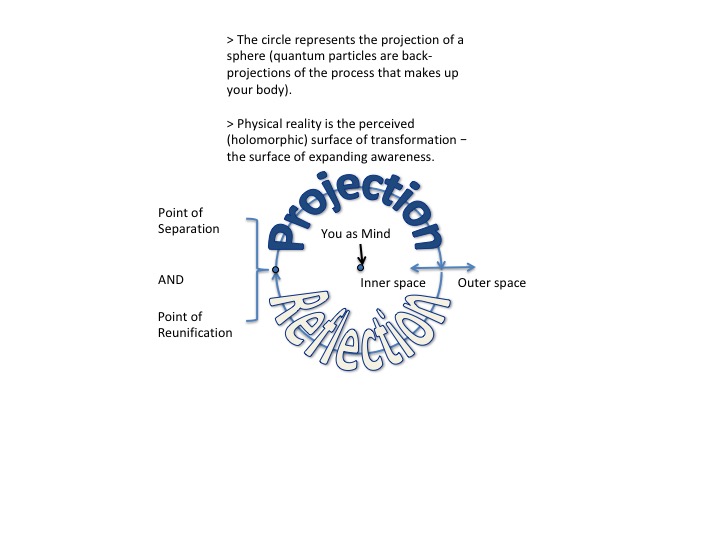
The cycle represents the process, which only requires two dimensions to hold and display its progression. But the result or “product” of the process (the holographic projection) requires a third dimension, as shown in the next figure, because it “transcends” the two, individual components (projection and reflection). So the projected 3-D holographic image is able to show all of the information that was “hidden” in the two dimensions, which represent the two “beams” that produced it. The individual beams are both signals in the same sense that a radio beam is a signal. It is modulated with information and must be demodulated by a radio receiver. In this case, the three-dimensional sphere represents the demodulated image. This is also analogous to a 2-D radiographic image, like an X-ray film that contains information about the anatomy, collapsed or modulated (as modules) into the film in the form of optical density. A CT scanner has to take at least two images from different perspectives and apply mathematical transform functions, like Fourier transforms and deconvolution integrals (for those who know the math), in order to “reconstruct” anatomical information in 3 dimensions. But for a hologram, this demodulation and reconstruction happens naturally and automatically if the process is not stopped.
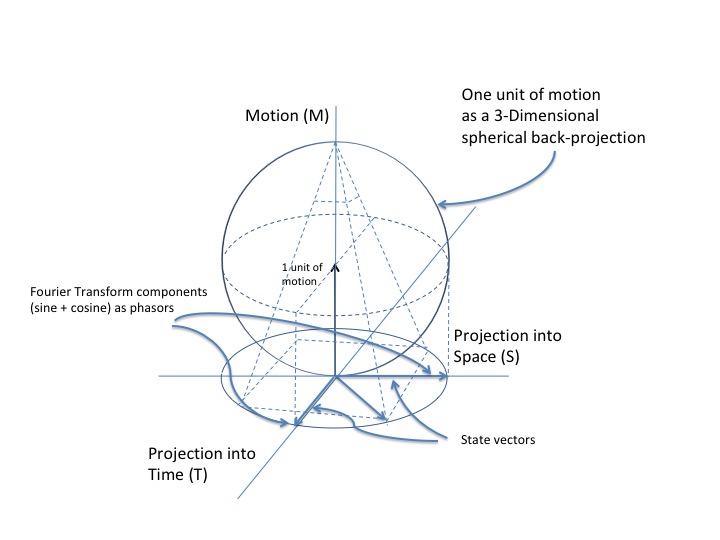
The subconscious mind does the same thing when energy is received in the form of vibrations (which can be represented as 2-D: at positions in space at moments in time). It reflects the information into individual events (qbits), collapsed or modulated in every cell of the body as DNA. These molecules form a memory bank and serve as the holographic fringes in the body recording every event in our lives. Because they are organic and flexible, they unfold into 3-D forms that form our cells. As the body grows its physical senses, the mind grows a mental sense (the mind’s eye) that allows the transform functions to naturally project holomorphic images, which take the shape of something that has meaning. In other words, the mind makes sense out of images and that sense adds to the growth of the mind’s eye so the meaning can be seen more clearly the next time it is observed.
In a CT machine, the transform-functions had to be discovered by mathematicians and entered by programmers. But the mind is part of the process itself, which in its very essence is a harmonic, auto-feedback oscillator. Stephen Grossberg, a renowned neuroscientist, and professor emeritus from Boston University discussed the same idea, calling it the “Adaptive Resonance Theory (ART)” in his recent book, Conscious Mind, Resonant Brain: How Each Brain Makes a Mind (Oxford University Press, 2021). He describes the brain makes the mind, but I’m not sure if he includes how the mind makes the brain, which is an enormous collection of self-organizing, closed-loop feedback cell-systems with inputs and outputs and involves both the physical and mental aspects as two parts of a whole. In that sense, the mind also makes the rest of the body. According to the holomorphic process theory, the mind also separates and projects a “thinking self” (the projection an an emotional process) that needs to reflect on the “knowing self” (the reunification as a cognitive process). I’m still reading the book, so I’ll try to update this page if I need to. This relates to the holographic model in that the thinking self correlates to a virtual image and the knowing self is what grows with each reunification.
There is also something called psychophysical parallelism, which states that “the chains of physical and of mental events run side by side, in some way corresponding to each other, but without mutual interference.” (von Bertalanffy, 1964) The holographic model explains the way they correspond to each other.
The Space-Time-Motion model
How does this compare to the current consensus model of physics? The first step in the holomorphic process is to separate motion into two apparently different yet coherent forms as a unit of space and a unit of time. According to the current model of physics the “spacetime continuum” is framed as a 4-dimensional tensor. The framework is based on the difference between space and time but then space is unfolded as 3-D and time as 1-D. Mathematically there is nothing wrong with that but it is not necessary and creates a dichotomy. It assumes that time is, in fact, an independent and very different kind of one-dimensional phenomenon, and it forces interpretations of reality that are warped, pinched, twisted and folded (like a long skinny balloon that clowns used to make figures). Instead, I use the space-time-motion diagram, i.e. just space versus time with motion as the third dimension, perpendicular to space (still represented as one dimension) and time.
Motion is “the real thing,” the form of energy that is conformally projected onto the space-time “plane”. Space and time have to be presented as two different ways of scaling motion – time being the denominator that we normally use as an “independent variable.” Each unit of time, regardless of how large each unit is, quantizes and therefore normalizes motion – collapsing it into one revolution of a clock. That makes space the “dependent variable.” In my approach, I use space and time as unitless quantities so that the speed of light is also unitless. This is not new, in fact, in Quantum Field Theory, “it is customary to choose units so that c=1 and h(bar)=1. We can always do this because the definition [of these constants] depends on certain conventions that grew historically in our understanding of nature. Imposing c=1 for example, means that seconds and centimeters are treated on the same footing, such that 299,792,458 meters is equivalent to 1 second. Thus, the second and the centimeter are treated as if they are expressions of the same unit.” (Kaku 1993)
My approach is exactly that, treating space and time as if they are expressions of the same unit, i.e. energy. With that, I approach the concept of spacetime a little differently as well. We perceive a unit of mass as being constant (in size) so a common way to visualize curved spacetime is to imagine a sphere sitting on a 2-D “fabric of spacetime” that curves continuously “downward” like a funnel formed by a unit of mass. So gravity is seen as the effect of mass “falling” down into the “funnel”. My approach provides the same result (gravity) but I use a different reference and come up with a bitwise process rather than a continuous curve. I use the two forms of quantum energy expressed as a phasor (phase vector) pair in terms of temporal frequency (E=hf) and spatial frequency (E=hc/λ) as shown below. By superimposing the quantum phasors (scaled as the inverse domain, i.e. 1/space and 1/time) on a relativistic space-time background, I illustrate how the two perspectives (phasor and vector) diverge with motion, causing one phasor to rotate to the left and one to the right, and the relativistic vector to extend outward as a conformal projection, appearing to be magnified by the Lorentz factor. Since relative motion is ubiquitous, the phasors become misaligned with the vector (their slopes) and the misalignment of represents a phase difference between the two perspectives of the same energy, giving rise to the curvature of space. But then, because time is treated as a measure of motion, the reference point on the time axis (the infinitesimal circle at the origin of the plot) also expands and the base of the vector moves to the right on the time axis (forward in time).
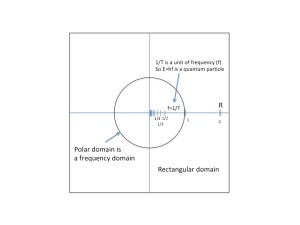
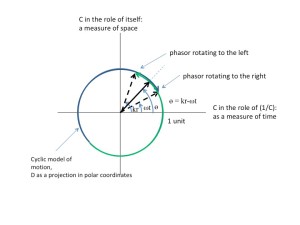
At a critical point, which should correlate to the end of one holomorphic cycle, the slope of the vector and the slope of the phasor are equal (which happens to be equal to the Golden Ratio as shown in the figure below), so to an observer, the two look identical to each other but slightly rotated with respect to the original. Rotating the reference frame to line the vector back up with the diagonal (where the speed of light is constant) results in what appears as spin. The same process happens simultaneously with the other phasor, rotating to the right. The reference point on the space axis (the infinitesimal circle at the origin of the plot) also expands and the base of the vector moves up on the space axis (outward in space).
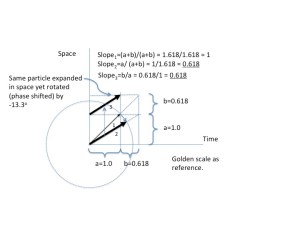
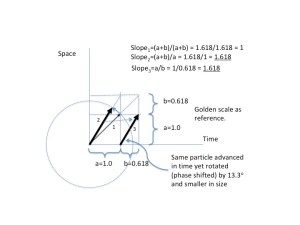
In effect, the fabric of spacetime expanded slightly and then collapsed, pulling the surrounding field (3-D fabric of spacetime) toward the center of the quantum particle. When you look at it like this, every quantum particle is the same as a black hole with a Planck-sized event horizon. Any disturbance in the surrounding field is also pulled toward the center with every event. The event horizon then serves as the boundary between past and future – the inner and outer domains – so any disturbance in the surrounding field Fourier-transforms into bits of information and is effectively stored in “inner space” – the quantum domain. In the quantum domain, although there is always a minimum amount of uncertainty, entropy (or the measure of disorganization) is decreased. It is a reflection of “outer space” where entropy always increases. Inside the boundary, space and time, or position and momentum, serve as the fringes required for the formation of holographic images. Each reunification transforms the holographic images into holomorphic units with minimum uncertainty, so that the whole is what we can say with confidence, is our knowing self.
 The Holomorphic Process